EN
EN


Commercial Bounce House vs Inflatable Jump House: What Buyers Should Compare
For a rental operator, distributor, or event-equipment buyer, the phrase inflatable jump house can mean several things. It may describe a compact children’s bouncer, a classic commercial castle, or a larger combo unit with a slide. “Commercial bounce house” is often used in the same conversation, but it signals a different buying question: will the unit fit repeated setups, the intended guest flow, and the documentation your market expects?
The useful comparison is not simply which name sounds more professional. Start with the operating model. A unit for occasional backyard use and an inflatable jump house intended for rental rotations can look similar in a photo while requiring very different decisions about size, entry layout, supervision, replacement parts, and transport. For distributors, it also helps to separate the customer’s product language from the specification checklist used to source it.
Are “commercial bounce house” and “inflatable jump house” different products?
Not necessarily. In many buyer conversations, inflatable jump house, bounce house, bouncy castle, and bouncer are overlapping category terms. The name may change by market, customer segment, or product shape. A commercial bounce house usually refers to the intended duty cycle and business use rather than a single fixed design.
That distinction matters because search results commonly mix residential pages with rental- and event-oriented offers. If you are buying for a fleet, avoid treating the wording alone as proof of commercial suitability. Ask the supplier to clarify the intended use, supported configuration, operating instructions, and the specific documents available for your destination market.
| Comparison point | What the term may tell you | What still needs verification |
|---|---|---|
| Inflatable jump house | Usually identifies the play category: enclosed or open bouncing space. | Dimensions, user group, entry design, and whether the unit suits repeated deployment. |
| Commercial bounce house | Usually signals rental, event, school, camp, or other repeat-use positioning. | Construction details, warranty scope, maintenance requirements, and market-specific compliance needs. |
| Combo bouncer | Signals added activity features such as a slide or obstacle section. | Footprint, staffing plan, capacity management, and packing/transport implications. |
Compare the business use before comparing the shape
For consideration-stage purchasing, start with where the inflatable jump house will earn its place in the product mix. A party-rental business may prioritize fast turnover, practical loading, and a design that works across common birthday themes. An event planner may care more about visual impact, queue flow, and an activity format that fits a venue plan. A distributor may need several styles that give resellers clear price and use-positioning choices.
Rather than seeking a single preferred model, define the primary job: family-party rental, school or community event, seasonal promotion, indoor play venue, or a multi-activity attraction. Then define the guest group and the space available. If the site conditions are not confirmed, keep dimensions, access routes, power planning, and anchoring arrangements on the approval list rather than making assumptions from a catalog image.
Evaluate the complete operating footprint
The floor outline of an inflatable jump house is only one part of its footprint. Buyers should map a practical setup area that includes entry and exit circulation, operator visibility, blower placement, cords or power access, anchor points where applicable, and a safe boundary around the attraction. A larger slide combo can create a stronger rental offer, but it can also change loading, staffing, and site-selection requirements.
Common mistakes come from comparing only the visual size or the headline price while leaving setup conditions for later. For a commercial purchase, request packed size and weight, the recommended blower configuration, setup guidance, cleaning and storage instructions, repair-kit contents, and the lead time for replacement components. These details help a fleet operator estimate labor and reduce avoidable downtime.
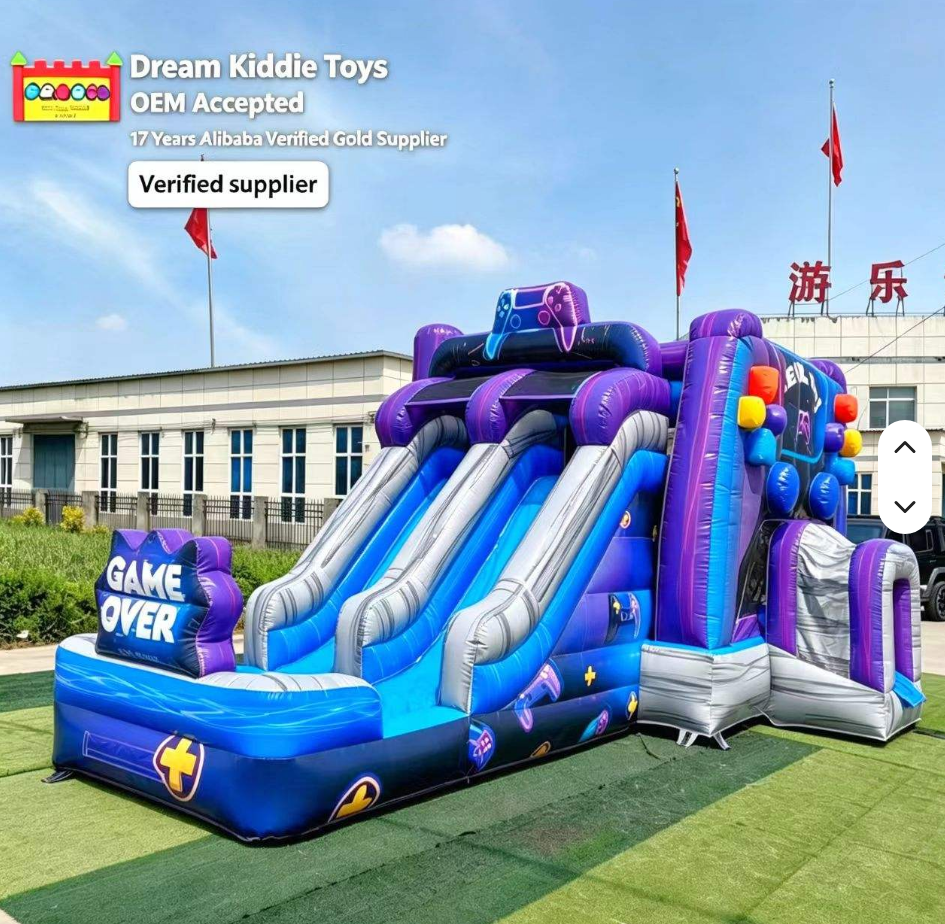
A bouncer-and-slide format can change the site, transport, and operating questions buyers need to compare.
Make safety and documentation part of the quote comparison
Safety is not a badge that can be assumed from the words commercial bounce house or inflatable jump house. Requirements vary by country, venue, insurer, and buyer type. A practical request-for-quotation should ask what operating instructions, labeling, material information, inspection-related documents, and support records are available. The buyer should then check them against local rules and their own insurer or venue requirements.
Also compare the design features that affect day-to-day supervision: clear entrances, visibility across the bouncing area, age or user separation plans, rules signage, and the ease of stopping use when weather or site conditions change. The right answer depends on the attraction and location, so suppliers should describe the configuration rather than make broad compliance promises.
Assess supplier support and product-range fit
When evaluating commercial bounce house suppliers, the product itself is only part of the decision. Buyers managing several rentals or reselling to operators usually benefit from a supplier discussion that covers product range, customization boundaries, spare-part communication, order packaging, and how technical questions are handled before and after shipment.
For example, a commercial-grade bouncer slide combo inflatable bounce house can be reviewed as one option within a broader rental-oriented mix. The linked product title confirms its category and party-rental positioning; buyers should still request the specific dimensions, materials, accessories, and documentation required for their order rather than infer them from the name.
A buyer checklist for the final comparison
- Confirm the target use, guest group, venue type, and expected setup frequency.
- Compare usable play area and full operating footprint, not only the front-view design.
- Request packing, transport, blower, anchoring, cleaning, storage, and repair information.
- Review available operating and product documentation against local requirements.
- Clarify what is included in the quoted configuration and what requires separate approval.
- Evaluate supplier communication, product-range fit, and replacement-part support for the intended fleet.
Choose the term that helps you buy the right configuration
In practice, an inflatable jump house and a commercial bounce house may describe the same broad family of attractions. The better purchasing decision comes from converting that broad label into a clear operating brief. For rental companies, distributors, and event buyers, a side-by-side comparison of setup conditions, operating needs, documentation, and supplier support is more useful than a naming debate.
Use the product name to start the conversation, then use the checklist to make the order specific. That approach makes it easier to compare quotes fairly and build a commercial inflatable range that matches the events, venues, and customers you actually serve.